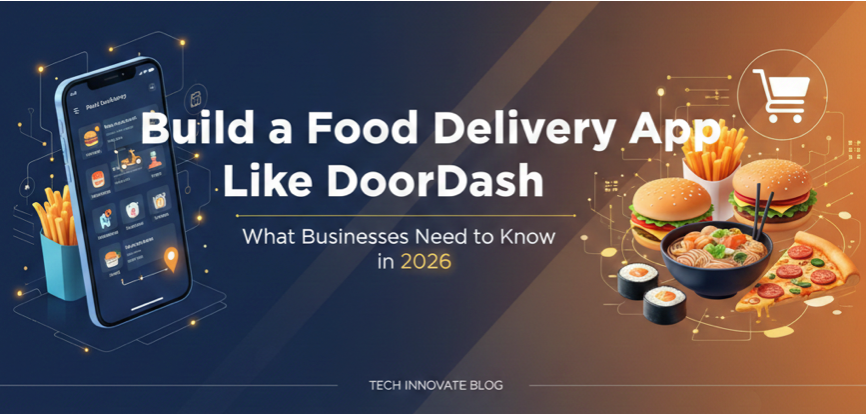
The food delivery economy continues to reshape how consumers order meals and how restaurants reach customers.
In 2026, many entrepreneurs, restaurant groups, and local startups are actively exploring how to build a food delivery app like DoorDash to capture growing demand for on-demand convenience.
As competition intensifies, success depends on more than launching an app—it requires scalable technology, hyperlocal strategy, and long-term market awareness. For businesses evaluating development frameworks, feature requirements, and cost considerations, insights from Build a Food Delivery App Like DoorDash help clarify what it takes to enter and compete in this fast-moving industry.
Why Food Delivery Apps Continue to Grow in 2026
Food delivery platforms have evolved from convenience tools into essential digital infrastructure for restaurants and consumers alike.
Busy lifestyles, mobile-first behavior, and demand for contactless services continue to drive adoption across U.S. cities, including fast-growing markets like Nashville.
Restaurants benefit from extended reach without expanding physical space, while customers enjoy real-time tracking, flexible payment options, and personalized recommendations.
This sustained demand makes food delivery one of the most resilient segments of the on-demand economy.
What Makes DoorDash-Style Platforms Successful
Understanding how to build a food delivery app like DoorDash requires examining the core elements behind its scale and reliability.
Successful platforms prioritize operational efficiency, user experience, and logistics intelligence.
Key success factors include:
- Intuitive mobile interfaces for customers and drivers
- Real-time order tracking and notifications
- Smart delivery assignment and route optimization
- Secure and flexible payment processing
- Robust admin controls for vendors and operations
In 2026, leading apps also leverage AI for demand forecasting, delivery optimization, and personalized user experiences.
Essential Features for a Modern Food Delivery App
Building a competitive food delivery platform requires coordinated functionality across multiple user roles:
Customer App
- Restaurant discovery and filtering
- Menu browsing and customization
- Multiple payment options
- Live delivery tracking
- Ratings and reviews
Restaurant Dashboard
- Menu and pricing control
- Order status management
- Sales analytics and reporting
Delivery Partner App
- Order alerts and navigation
- Earnings overview
- Route optimization
Admin Panel
- Commission and fee management
- Vendor and user controls
- Marketing and promotion tools
Together, these components form a complete ecosystem rather than a standalone ordering tool.
The Shift Toward Hyperlocal Delivery Models
One of the most important trends shaping food delivery in 2026 is the rise of hyperlocal platforms. Instead of competing nationally, many businesses are launching city-specific or neighborhood-focused apps that better serve local demand.
Hyperlocal delivery apps allow businesses to:
- Reduce delivery time and logistics costs
- Partner with local restaurants and cloud kitchens
- Offer personalized neighborhood experiences
- Expand into groceries, convenience, and local retail
Entrepreneurs considering this approach can explore innovative hyperlocal delivery app ideas that extend beyond food into broader last-mile commerce opportunities.
Server Infrastructure and Scalability Requirements
Behind every successful food delivery app is a highly scalable server architecture. In 2026, platforms rely heavily on cloud-based infrastructure and microservices to handle real-time order processing, GPS tracking, notifications, and payment transactions.
Key server considerations include:
- High availability to support peak-hour traffic
- Auto-scaling cloud infrastructure
- API-driven architecture for integrations
- Secure data handling and encryption
- Minimal downtime and fast response times
Scalable server architecture ensures that as user demand grows—whether citywide or hyperlocal—the platform remains reliable and responsive.
Market Size and Five-Year Growth Outlook
The food delivery and hyperlocal delivery app industry is expected to maintain strong growth over the next five years. Industry analysts project continued expansion driven by mobile adoption, subscription delivery models, AI-powered logistics, and increasing participation from independent restaurants and cloud kitchens.
By the early 2030s, the global market value of food and hyperlocal delivery platforms is expected to reach several hundred billion dollars, with regional and niche platforms capturing a larger share of consumer demand. Industries benefiting most from this growth include:
- Food and beverage delivery
- Cloud kitchens and virtual brands
- Grocery and convenience delivery
- Local retail and hyperlocal commerce
- Logistics and last-mile delivery services
For businesses planning long-term investments, building a food delivery app with scalable servers and flexible architecture is a strategic necessity—not just a technical decision.
Choosing the Right Development Partner
Developing a food delivery app like DoorDash requires expertise across mobile development, backend systems, UI/UX design, logistics workflows, and scalability planning.
Many businesses choose experienced development partners that understand both technology and on-demand business models.
Companies such as Amarin InfoTech work on end-to-end food delivery and hyperlocal app development, helping businesses translate operational ideas into scalable digital platforms.
Their approach reflects a broader industry shift toward customized, market-specific delivery solutions.
Final Thoughts
In 2026, building a food delivery app is no longer about copying existing platforms—it is about creating smarter, localized, and more resilient digital ecosystems.
Businesses that invest in scalable server infrastructure, hyperlocal strategies, and strong user experience design are better positioned to succeed in competitive urban markets like Nashville.
For entrepreneurs and restaurant groups, understanding how to build a food delivery app like DoorDash—and adapting that model to local demand—can unlock sustainable growth in the evolving on-demand economy.