RIDGEFIELD, CT, July 13, 2026 /24-7PressRelease/ — Every experienced pediatrician, child psychologist, and child psychiatrist knows this child.
One week they’re thriving. The next… They refuse to eat. They develop obsessive fears. They can’t separate from their parents. They begin having motor tics. They explode in rage over the smallest frustrations. Or they wake up terrified, anxious, and no longer seem like themselves.
Parents almost always describe it the same way: “A switch flipped.”
Many add something even more heartbreaking: “It’s like I lost my child overnight.”
For some families, that sudden change marks the beginning of months — or even years — of searching for answers.
Children are often diagnosed with anxiety, obsessive-compulsive disorder (OCD), ADHD, eating disorders, or behavioral disorders. Those diagnoses may accurately describe the symptoms. But according to children’s mental health expert Dr. Roseann Capanna-Hodge, they may not fully explain what’s driving them.
Drawing on more than 30 years of clinical experience, analysis of more than 10,000 quantitative EEG brain maps, and her own family’s experience navigating PANS and Lyme disease with her son, Dr. Roseann believes one question is too often overlooked: What changed biologically?
At NeuroImmune Day, a leading conference on neuroimmune health, Dr. Roseann will challenge clinicians to look beyond symptoms and consider how the nervous system, immune system, and brain interact when a child changes almost overnight.
“When a child changes this dramatically, we have to ask a different question,” says Dr. Roseann. “Not simply, ‘What diagnosis fits these symptoms?’ but ‘What changed biologically that caused this child to change so suddenly?'”
Why Sudden Behavioral Changes May Have an Underlying Medical Cause
For decades, many children experiencing sudden psychiatric or behavioral symptoms have been viewed primarily through a mental health lens. Today, a growing body of research — and the clinical experience of practitioners treating infection-triggered neuroimmune illness — is encouraging a broader conversation.
Conditions such as PANS (Pediatric Acute-onset Neuropsychiatric Syndrome), PANDAS (Pediatric Autoimmune Neuropsychiatric Disorders Associated with Streptococcal Infections), Lyme disease, autoimmune encephalitis, and other neuroimmune disorders can trigger inflammation that affects the brain, immune system, and autonomic nervous system.
For some children, the result is a dramatic change that appears almost overnight.
What looks like anxiety may be neuroinflammation. What looks like defiance may be a nervous system locked in survival mode. What looks like a psychiatric disorder may have an underlying biological driver that deserves further medical evaluation.
Researchers estimate that PANS alone may affect as many as 1 in 200 children, yet many healthcare professionals receive little formal training in recognizing it. As a result, families often spend months — or years — moving from one specialist to another before the biological questions are fully explored.
“Parents often tell me, ‘This isn’t my child,'” says Dr. Roseann. “And they’re right. These children haven’t simply developed a behavior problem overnight. Something has changed in the biology that’s driving their behavior.”
Why Healing Begins With the Nervous System
One of the most frustrating experiences for families — and the clinicians caring for them — is watching children receive appropriate care while continuing to struggle.
The infection has been treated. The inflammation begins to improve. Therapy has started. Medications have been adjusted. Parents are doing everything they’ve been told to do. Yet some children remain stuck.
According to Dr. Roseann, one important question is often overlooked: What state is the child’s nervous system in?
“When the brain and body remain locked in chronic survival mode, healing becomes much more difficult,” she explains. “The nervous system influences everything from emotional regulation and executive functioning to sleep, digestion, immune function, and a child’s ability to benefit from therapy and medical treatment.”
Rather than viewing the nervous system as simply another body system, Dr. Roseann describes it as the body’s master regulator — continually communicating with the immune system, the gut, the endocrine system, and the brain.
“When the nervous system never receives the message that it’s safe,” she says, “the body continues behaving as though the threat is still present — even after the original trigger has begun to resolve.”
This understanding forms the foundation of Regulation First®, Dr. Roseann’s clinical framework, which views nervous system regulation as a biological prerequisite for healing rather than simply another therapeutic intervention.
At NeuroImmune Day, Dr. Roseann will present emerging research and clinical insights exploring how chronic nervous system activation influences immune function, sleep, gut health, vascular health, executive functioning, and emotional regulation — and why those systems cannot be treated in isolation.
“We can’t ask a child to heal while their nervous system still believes they’re under constant threat,” says Dr. Roseann. “Healing begins when the body finally receives the message that it’s safe.”
Why This Conversation Is Taking Center Stage at NeuroImmune Day
As research into infection-triggered neuroimmune conditions continues to evolve, more clinicians are exploring how the nervous system, immune system, brain, and body work together rather than treating them as separate systems.
That shift is bringing together pediatricians, neurologists, psychiatrists, psychologists, functional medicine practitioners, chiropractors, immunologists, therapists, and other healthcare professionals who are searching for more comprehensive approaches to complex pediatric illness.
At NeuroImmune Day, Dr. Roseann will present “PANS/PANDAS and the Whole-Body Matrix: Why Dysregulation Isn’t Just a Brain Issue,” exploring how chronic nervous system activation affects not only behavior, but immune function, sleep, gut health, vascular health, executive functioning, and the body’s overall ability to recover.
Rather than viewing nervous system regulation as simply a behavioral strategy, her presentation positions it as a biological foundation that supports the body’s capacity to heal.
“One of the most exciting things happening in health right now is that specialists who once worked independently are beginning to recognize how connected these systems really are,” says Dr. Roseann. “When we understand those connections, we open new possibilities for helping children who have remained stuck despite everyone’s best efforts.”
What Parents Should Do When a Child Changes Overnight
If your child suddenly develops intense anxiety, obsessive behaviors, motor tics, severe emotional dysregulation, food restriction, or other dramatic changes that seem to come out of nowhere, Dr. Roseann encourages parents not to wait.
“Trust what you’re seeing,” she says. “Those changes deserve thoughtful medical evaluation and a conversation with clinicians who understand the connection between the brain, the immune system, and the nervous system.”
For many families, simply learning that these sudden changes can have biological drivers brings enormous relief. “It doesn’t automatically provide all the answers,” says Dr. Roseann. “But it changes the questions we ask — and sometimes that’s where healing begins.”
Whether the underlying cause is infection-triggered neuroimmune illness, chronic inflammation, nervous system dysregulation, or another medical condition, Dr. Roseann believes one principle remains the same: children do better when we understand what their brains and bodies are experiencing — not when we assume they’re choosing to struggle.
The Dysregulated Kid: A Roadmap for Families Looking for Answers
For many parents, the search for answers doesn’t end after a diagnosis. It begins there.
They spend months reading articles, listening to podcasts, trying new therapies, and wondering why their child still struggles despite everyone’s best efforts.
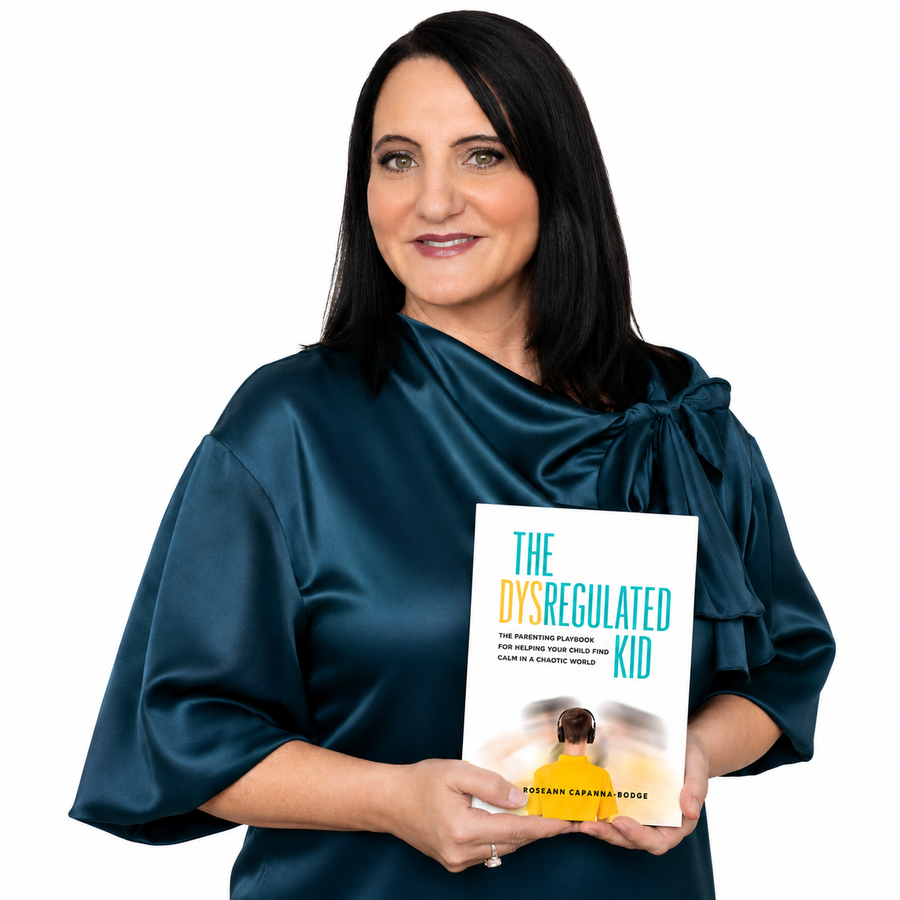
Dr. Roseann wrote The Dysregulated Kid: The Parenting Playbook for Helping Your Child Find Calm in a Chaotic World for those families.
Rather than focusing only on managing behavior, the book helps parents understand the biology driving behavior — and gives them practical, science-backed tools to help calm the nervous system, reduce emotional overwhelm, and build resilience over time.
Built around Dr. Roseann’s Regulation First® framework, the book introduces practical strategies families can begin using immediately, including the Love Pause®, CALMS Protocol®, RESET to Regulate®, and 10-Minute Resets.
“I wrote the book I wish every parent had the moment they realized, ‘Something has changed, and I don’t know what to do next,'” says Dr. Roseann. “Families don’t need more blame or more behavior charts. They need practical tools that help them understand what’s happening beneath the surface and what they can do about it.”
The Dysregulated Kid will be published by Page Two Books on September 22, 2026.
Pre-orders and exclusive bonuses: www.dysregulatedkid.com
Available for Television, Podcast, and Media Interviews
As conversations around children’s mental health, nervous system regulation, and neuroimmune disorders continue to grow, Dr. Roseann Capanna-Hodge is available for television, podcast, and media interviews on topics including:
Why Are Kids So Dysregulated? The Quiet Crisis Derailing Families
When a Child Changes Overnight: What Every Parent Should Know
Is Your Child’s Screen Time Rewiring Their Stress Response?
The Overwhelmed Parent Epidemic: Why Parents Are Burning Out, Too
When Behavior Isn’t the Problem: Why the Nervous System Comes First
Known for translating complex neuroscience into practical, compassionate guidance, Dr. Roseann helps parents, clinicians, educators, and healthcare professionals better understand the intersection of children’s mental health, nervous system regulation, and neuroimmune health.
About Dr. Roseann Capanna-Hodge
Dr. Roseann Capanna-Hodge, Ed.D., LPC, BCN, is a nationally recognized children’s mental health expert, licensed therapist, certified school psychologist, and Board Certified in Neurofeedback with more than 30 years of clinical experience helping children with anxiety, ADHD, OCD, emotional dysregulation, PANS/PANDAS, Lyme disease, and other complex neurodevelopmental and neuroimmune conditions.
She is the founder of Regulation First Parenting®, creator of the CALMS Protocol®, and author of the forthcoming book The Dysregulated Kid: The Parenting Playbook for Helping Your Child Find Calm in a Chaotic World. Drawing on insights from more than 10,000 quantitative EEG (QEEG) brain maps, Dr. Roseann has helped thousands of families better understand the connection between nervous system regulation, behavior, learning, and emotional health.
Her perspective is shaped not only by decades of clinical practice but also by her own family’s experience navigating PANS and Lyme disease with her son, giving her a unique understanding of both the science and the lived experience of families facing complex neuroimmune conditions.
Dr. Roseann has been featured in The New York Times, Forbes, Parents, NBC, CBS, Fox, and The Mel Robbins Show, and hosts the top-ranked Dysregulated Kids podcast with more than 2 million downloads worldwide. She is a sought-after speaker on children’s mental health, nervous system regulation, and neuroimmune disorders.
She will present “PANS/PANDAS and the Whole-Body Matrix: Why Dysregulation Isn’t Just a Brain Issue” at NeuroImmune Day, where she will share emerging clinical insights into how the nervous system, immune system, and brain interact in infection-triggered neuropsychiatric illness — and why understanding those connections may change the way clinicians and families approach healing.
Media Contact
Dr. Roseann Capanna-Hodge Media Inquiries: inquiries@drroseann.com Phone: 203-438-4848 Website: www.drroseann.com
—
For the original version of this press release, please visit 24-7PressRelease.com here
Legal Disclaimer: The content on this page is syndicated from independent third-party providers. Kyrion Media makes no warranties or representations regarding the accuracy, completeness, legality, or reliability of the information, including text, images, videos, or licenses. If you are affiliated with this content or have any complaints, copyright concerns, or requests for removal, please contact us at retract@kyrionmedia.com with the specific URL of the content in question. We will review and address valid requests promptly.