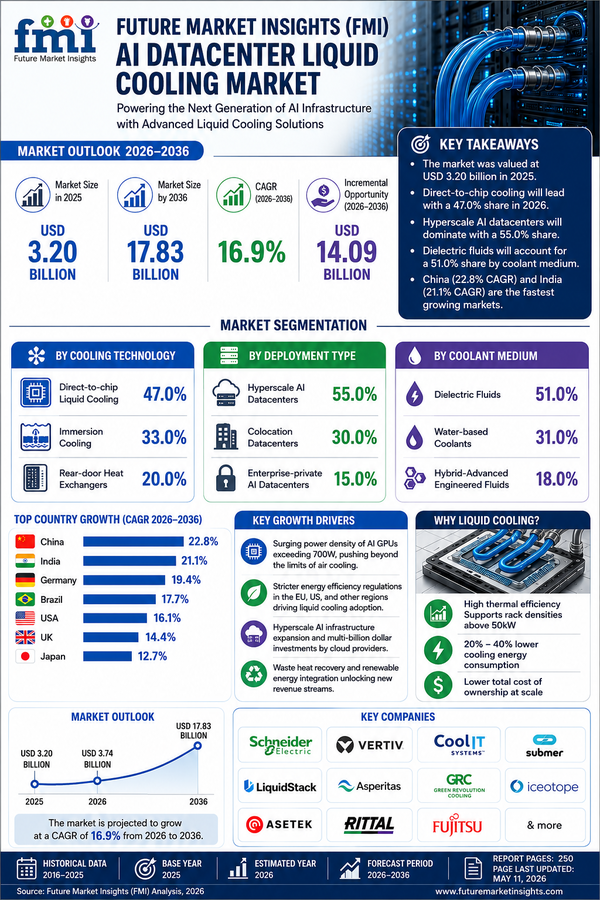
NEWARK, DE, June 16, 2026 /24-7PressRelease/ — The rapid evolution of artificial intelligence is transforming datacenter infrastructure worldwide, creating unprecedented demand for advanced thermal management solutions. According to Future Market Insights (FMI), the global AI Datacenter Liquid Cooling Market is projected to grow from USD 3.2 billion in 2025 to USD 17.83 billion by 2036, registering a robust 16.9% CAGR during the forecast period.
The market is expected to create an incremental opportunity of USD 14.09 billion between 2026 and 2036 as hyperscale cloud providers, AI developers, and colocation operators increasingly transition away from conventional air-cooling systems.
The shift is being driven by a simple reality: modern AI infrastructure generates more heat than traditional cooling technologies can efficiently handle.
AI Compute Density Reshaping Datacenter Design
As AI training clusters become larger and more powerful, rack power densities are rapidly moving beyond 50kW and approaching 100kW in some deployments. Today’s advanced AI accelerators can consume more than 700 watts per GPU, creating thermal loads that challenge conventional cooling architectures.
Liquid cooling has emerged as the preferred solution because it delivers significantly higher heat-transfer efficiency while reducing energy consumption and improving system reliability.
“Liquid cooling is no longer a specialized infrastructure upgrade,” said an FMI analyst. “For AI-focused facilities operating high-density GPU environments, it is becoming a foundational requirement that directly impacts performance, energy efficiency, and operational economics.”
Request Access the Full Premium Report Today to Identify High-Growth Opportunities Across Hyperscale AI Infrastructure, Liquid Cooling Technologies, and Next-Generation Datacenter Investments.
– https://www.futuremarketinsights.com/reports/sample/rep-gb-24977
Direct-to-Chip Cooling Leads Technology Adoption
Among cooling technologies, direct-to-chip liquid cooling is expected to account for 47% of market revenue in 2026.
The technology cools processors and GPUs through liquid-filled cold plates mounted directly on heat-generating components. Because it integrates with existing server architectures, operators can retrofit facilities without undertaking costly datacenter redesigns.
This combination of efficiency and deployment flexibility is accelerating adoption across both hyperscale and enterprise environments.
Meanwhile, immersion cooling and rear-door heat exchanger technologies continue gaining traction in ultra-high-density deployments where thermal requirements are becoming increasingly demanding.
Hyperscale Operators Drive Market Growth
Hyperscale AI datacenters are projected to represent 55% of global deployment demand by 2026.
Major cloud service providers are investing billions of dollars in AI infrastructure to support generative AI, large language models, machine learning platforms, and advanced analytics workloads. These facilities require scalable cooling systems capable of maintaining consistent thermal performance across thousands of GPUs operating simultaneously.
Long-term procurement agreements between cooling technology providers and hyperscale operators are becoming a defining feature of the market, creating stable revenue opportunities for suppliers.
Sustainability Becomes a Strategic Driver
Beyond thermal performance, energy efficiency has emerged as a major factor influencing purchasing decisions.
Datacenters currently account for a growing share of global electricity consumption, prompting regulators across North America and Europe to introduce stricter efficiency standards. Liquid cooling systems can reduce cooling-related energy usage by 20% to 40% compared with comparable air-cooled facilities.
Improved Power Usage Effectiveness (PUE) not only lowers operating costs but also helps operators meet sustainability targets and regulatory requirements.
The integration of waste-heat recovery technologies is creating additional opportunities. In several European markets, captured datacenter heat is being reused for district heating and industrial applications, generating secondary revenue streams while improving return on investment.
Asia Emerges as the Fastest-Growing Region
While North America remains the largest revenue-generating market, Asia is expected to deliver the strongest growth through 2036.
China leads global expansion with a projected 22.8% CAGR, supported by government-backed AI infrastructure initiatives, domestic semiconductor development, and large-scale datacenter construction programs.
India follows closely with a 21.1% CAGR, driven by hyperscale investments, rapid cloud adoption, and expanding AI workloads across financial services, telecommunications, and IT outsourcing sectors. Growing datacenter capacity in Mumbai, Chennai, and Hyderabad is creating substantial demand for liquid cooling systems.
Germany is also emerging as a key growth market, forecast to expand at 19.4% CAGR, supported by stringent EU energy-efficiency regulations and investments in sustainable datacenter infrastructure.
Competitive Landscape Intensifies
The market is characterized by growing competition between established datacenter infrastructure providers and specialized cooling technology developers.
Leading participants include:
Schneider Electric
Vertiv Holdings
CoolIT Systems
Submer Technologies
LiquidStack
Asperitas
Green Revolution Cooling (GRC)
Iceotope Technologies
Asetek
Rittal GmbH
Fujitsu Ltd.
Industry leaders are expanding product portfolios, strengthening hyperscale partnerships, and investing in manufacturing capacity to address accelerating demand from AI-focused datacenters.
For Customise and Country level Report, Request: https://www.futuremarketinsights.com/reports/brochure/rep-gb-24977
Future Outlook
As artificial intelligence becomes increasingly embedded across industries, datacenter operators face mounting pressure to support higher compute densities without compromising efficiency or reliability.
With AI workloads continuing to push thermal boundaries, liquid cooling technologies are expected to become a standard feature of next-generation datacenters rather than a niche solution.
By 2036, the AI Datacenter Liquid Cooling Market is expected to play a critical role in enabling the global AI economy, supporting everything from hyperscale cloud platforms and sovereign AI initiatives to enterprise AI deployments and high-performance computing environments.
Related Reports:
. Liquid Cooling Quick Couplers Market: https://www.futuremarketinsights.com/reports/liquid-cooling-quick-couplers-market
. Data Center Liquid Cooling Market: https://www.futuremarketinsights.com/reports/data-center-liquid-cooling-market
. AI Server Chassis Market: https://www.futuremarketinsights.com/reports/ai-server-chassis-market
. Liquid-Cooled Edge Data Center Market: https://www.futuremarketinsights.com/reports/liquid-cooled-edge-data-center-market
. Datacenter Infrastructure Services Market: https://www.futuremarketinsights.com/reports/datacenter-infrastructure-services-market
About Future Market Insights (FMI)
Future Market Insights is a leading market research and consulting firm providing syndicated research, competitive intelligence, and strategic advisory services across technology, industrial, healthcare, energy, and consumer sectors worldwide
—
For the original version of this press release, please visit 24-7PressRelease.com here
Legal Disclaimer: The content on this page is syndicated from independent third-party providers. Kyrion Media makes no warranties or representations regarding the accuracy, completeness, legality, or reliability of the information, including text, images, videos, or licenses. If you are affiliated with this content or have any complaints, copyright concerns, or requests for removal, please contact us at retract@kyrionmedia.com with the specific URL of the content in question. We will review and address valid requests promptly.